
Yes, you can build a pole barn in the winter in Ontario, and more of them go up between December and March than most people expect. Post-frame construction is unusually well suited to cold weather, because the parts that hate winter are the parts a pole barn uses least. There’s no block foundation curing in the cold, no mortar, no waiting on a full basement pour. Holes get augered, posts get set, trusses go up, steel goes on. The building can be closed in while the ground is still hard. What winter actually changes isn’t whether you can build. It’s sequencing, concrete, and how honest your contractor is about the calendar.
If you’re weighing a build for the first time, it helps to understand the way a post-frame building actually gets scheduled and erected before you pick a season. The same goes for farm and equipment buildings sized around real machinery, where the timing usually has to work around planting or harvest rather than around the weather.
Can you build a pole barn in the winter in Ontario?
Yes. Building a pole barn in the winter in Ontario is common practice, especially between December and March, because post-frame construction skips the concrete-heavy, weather-sensitive steps that slow down other building types. The short version comes down to three things: frozen ground doesn’t stop the posts from going in, concrete can be poured with cold-weather practice or deferred to spring, and the real cost of building through winter is a slightly slower schedule, not a stalled one.
Does frozen ground stop you from setting posts?
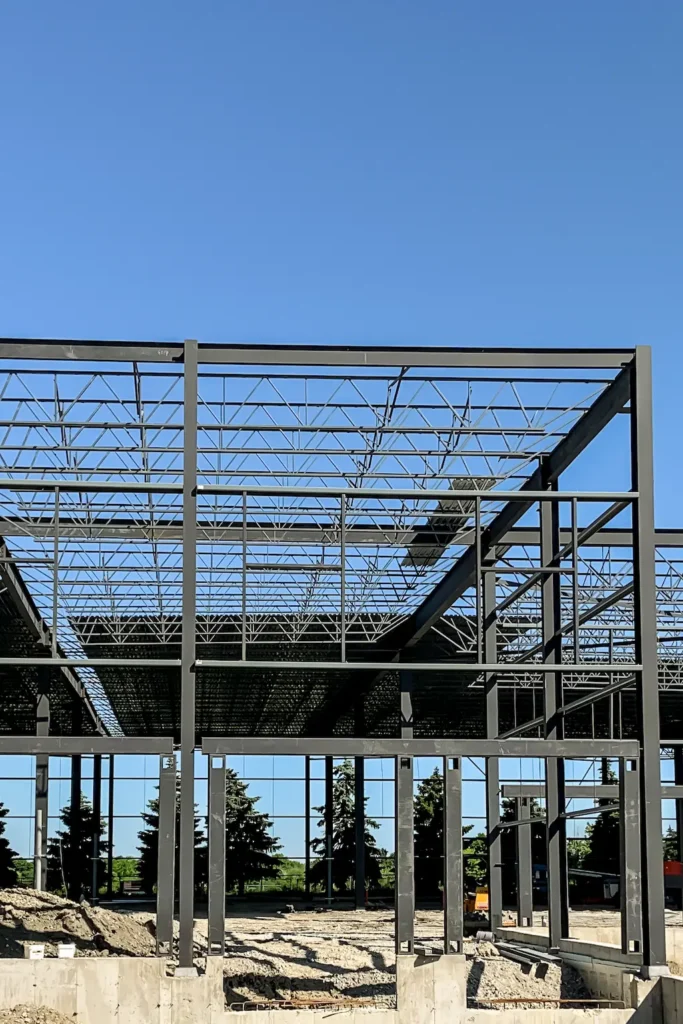
Not in the way people imagine. Frost in this part of Ontario works down from the surface as the winter goes on, and a machine-augered hole punches through that crust readily enough in December or January. Late February, after a long cold stretch with little snow cover, is harder going. Snow is an insulator, and a bare frozen field freezes deeper than a drifted one.
What matters far more than whether you can dig is where the hole bottoms out. Every post has to bear below the local frost line, on undisturbed soil, at the depth your municipality’s building department specifies for your site. That rule doesn’t relax in winter. If anything it gets enforced more carefully, because a post bearing on frozen ground rather than through it will lift when that ground heaves, and the building will tell you about it come April.
The other winter detail is backfill. Frozen chunks of spoil dumped back around a post do not compact. They sit there as voids waiting for spring. Backfill has to be workable material, placed and tamped properly, or the post is loose the moment things thaw.
Can you pour concrete in Ontario winter?
You can, with cold-weather practice, and it is done constantly. Concrete cures through a chemical reaction that generates its own heat; the job in winter is protecting that heat long enough for the mix to gain strength before it can freeze. That means heated mix from the plant, ground thawed and prepared beforehand, insulated blankets, sometimes hoarding and heat.
All of that is normal and all of it costs time and money. Which is why a lot of winter post-frame jobs simply split the work: shell up over the winter, slab in the spring. A pole barn doesn’t need its floor to stand, and deferring the pour until the frost is out of the ground removes the fussiest, most weather-dependent item from the schedule. For a storage or equipment building, gravel through the first season is perfectly reasonable. For a heated shop where the slab is part of the insulation strategy, it’s worth waiting to do it right.
What’s actually the best time of year to start a post-frame build?
Ask ten builders and you’ll get a real split, but the honest answer is that the best time to start the conversation is autumn, and the best time to break ground depends on what the building is for.
Plenty of owners weighing a pole barn in the winter in Ontario against waiting for spring find that winter wins on scheduling alone. Late fall and winter have genuine advantages. Crews are less stretched than they are in June. Lead times on trusses and steel are usually shorter in the off-season than in the spring rush. Frozen ground means machinery isn’t churning a farm lane into a mud track, which matters enormously on a working property. And a building closed in by March is usable for the whole season ahead rather than half of it.
Spring and early summer are the crowded end of the calendar. Everyone who thought about a barn in January calls in April, which is exactly when municipal building departments are busiest and when the ground is at its softest and worst for equipment access.
What does winter add to the schedule?
Days, not months, but unevenly, and that’s the part worth planning around. Short daylight is the quiet cost: a crew simply gets fewer productive hours between December and February. High wind shuts down truss setting and steel work outright, and winter brings more of those days. Snow has to be cleared from the site and from materials before anything happens.
The realistic way to handle it is to build slack into the plan rather than a fixed completion date, and to get the permit application in well ahead of the build. Drawings, site plan, and approvals move at their own pace regardless of the weather, and a winter start with an approved permit already in hand is a much calmer thing than a winter start waiting on paperwork.
What should a Colborne or Cramahe Township owner sort out first?
Zoning before anything else. Cramahe Township, like most of Northumberland, sets limits on accessory buildings: how large a detached structure can be, how far it has to sit from the lot lines and the road allowance, and how much of the lot can be covered. Agricultural properties are treated differently from residential ones, and a genuine farm building falls under a different set of rules than a hobby shop that happens to be on a rural lot. That distinction decides the whole scope of the project, so it’s the first call to the township office, not the last.
There’s one more Colborne-area timing wrinkle that catches people out, and it’s specific to rural builds. Municipalities across the county post reduced load limits on their roads during the spring thaw, when the base under the gravel is soft. Trusses, steel, lumber and concrete all arrive on heavy trucks. A build scheduled to receive its materials right as those restrictions go up can stall for weeks through no fault of anyone on site. Getting deliveries in while the ground is still frozen, or waiting until the restrictions come off, is a real scheduling factor around here, and the township can tell you the dates for your concession.
We work out of our shop in Campbellcroft, across the roughly hour-and-a-half radius around Port Hope: Northumberland, Kawartha Lakes, Durham, Peterborough County, and south to the lake. If you’re thinking about a building for next season, the useful thing to do this month isn’t to pick a start date. It’s to get the site walked, the zoning confirmed, and the drawings moving, because that’s the part of a pole barn in the winter in Ontario that the weather can’t speed up.